Classroom games for interactive whiteboards
For the whole class in teams, for one child alone, or each on their own tablet in the same game. Early years to Year 6, nothing to install and no adverts.
Tug of war: every right answer pulls the rope
Also free and unlimited: the blank whiteboard and the timer.
Ways to play
Two teams, one screen
The classroom classic: the board split in two, one team on each side, at the same time or by turns.
One child alone
The same screen for one, with puzzles instead of a rival. For extra support or for home.
Two screens
Each on their own tablet with the same challenges. One creates a room, reads out a four-letter code and the other joins.
Only the one who creates the room pays: the guest plays free, with no account.
Try it without signing up
5 free games, no account and no details needed. After that, a single payment of €9.99 unlocks all 78 games for ever, on every device. No subscription, no renewals.
Start the first gameThe games
Sorted by year group. Every game has its own levels inside, so one game covers the whole class and also works for extra support.
You can tick more than one.
78 games
Maths
23 games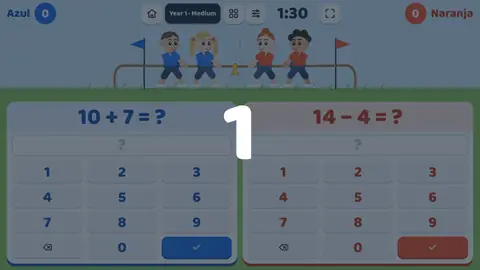
Tug of war
Solve to pull the rope. The first team to drag the marker to their side wins.
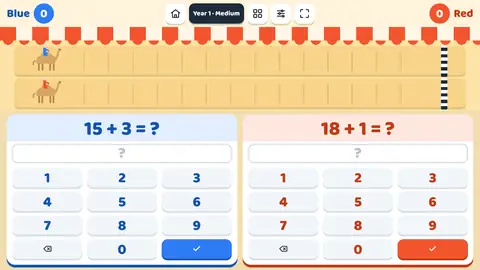
Camel race
Answer to move your camel forward. First one to the palm trees wins.
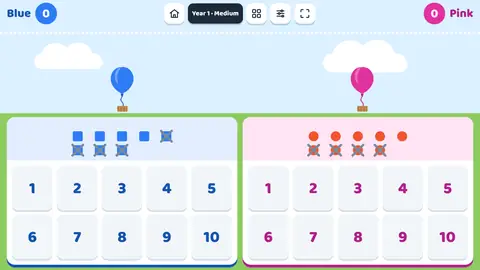
Balloon race
Count and tap the number. Each right answer lifts your balloon.
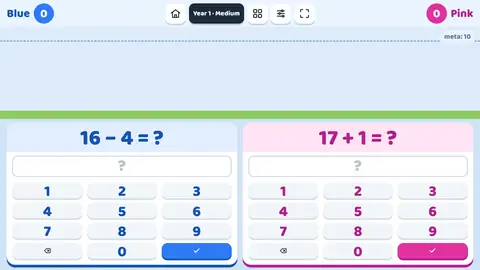
Block tower
Every right answer adds a block. The tallest tower wins.
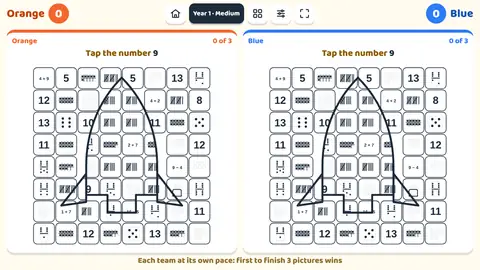
Colour by code
Tap only the squares that match the rule and the hidden picture appears. Eight levels, from counting to times tables, measures and fractions.
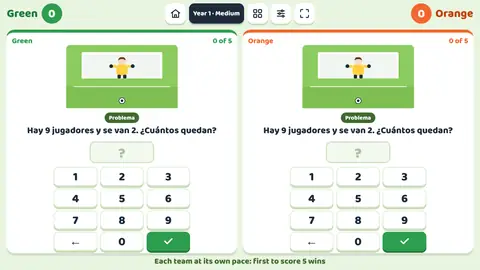
Penalty shootout
Each team in its own goal: solve a challenge to earn the shot, then aim with the moving target against the keeper.
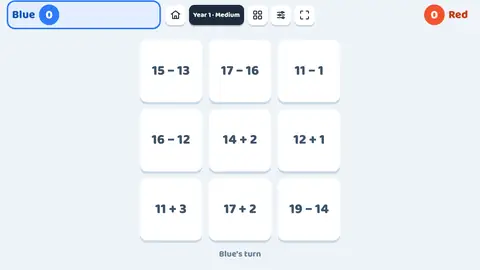
Maths tic-tac-toe
Take a square by solving the operation inside it. Three in a row wins.
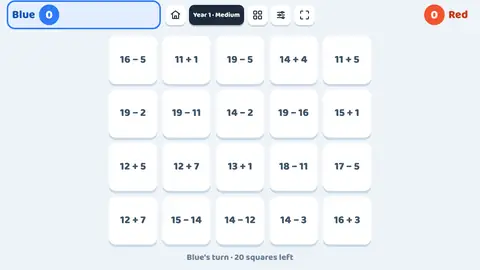
Square conquest
Take squares by answering. The team with the most squares wins.
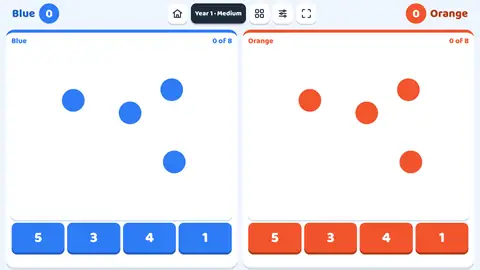
How many are there?
A quantity appears drawn in different ways: on a ten frame, with fingers, dice or tally marks. Each team taps the number on their side.
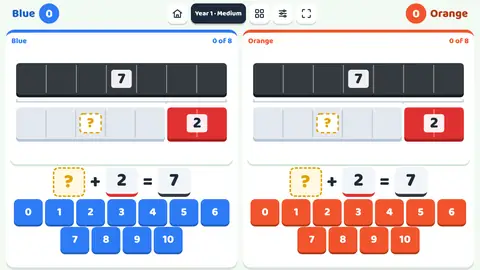
The two parts
A whole bar splits into two pieces. One is shown and you work out the other by completing the number sentence: sometimes as an addition, sometimes as a subtraction.
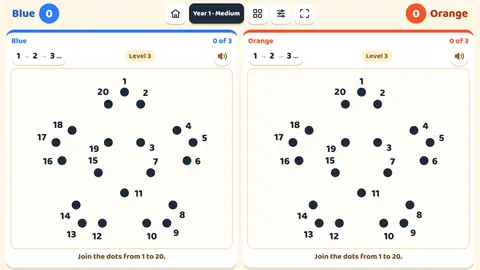
Join the dots
Numbered dots hide a picture: join them in order by tapping or sliding your finger, and when the picture is closed it fills with colour and comes to life. From 1 to 5 with big numbers up to counting in 5s to 100 with extra numbers that do not belong; also backwards and by letters.
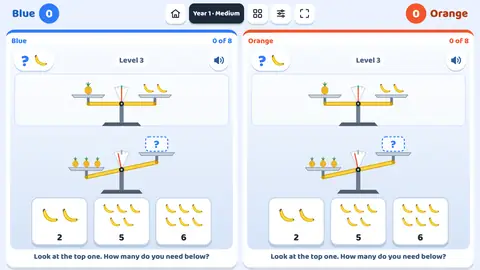
The scales
A balance scale with two pans: the side that goes down is heavier. Read the scale, balance it with cubes, find equivalences (if a pear weighs as much as two strawberries, how many strawberries weigh as much as two pears?) and order by weight. Five levels, from age 3.
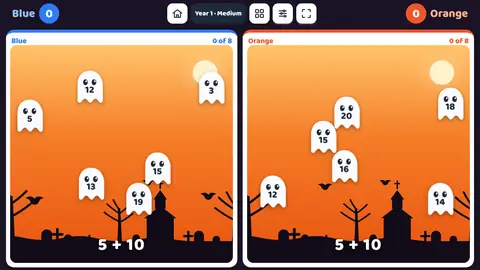
Catch the ghost
Ghosts drift over the graveyard, each carrying a number. A sum appears at the bottom and you tap the ghost with the answer before the other team. You choose the operation, how many ghosts and how fast they fly.
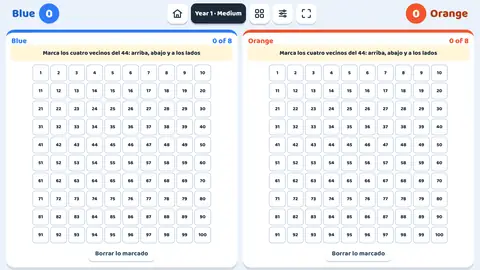
The hundred square
The classic number grid for the whiteboard. In free mode the teacher leads: colour in numbers, hide them, and call up prompts (“mark every number with 4 tens”) that check themselves. In challenge mode two teams race on their own grids.
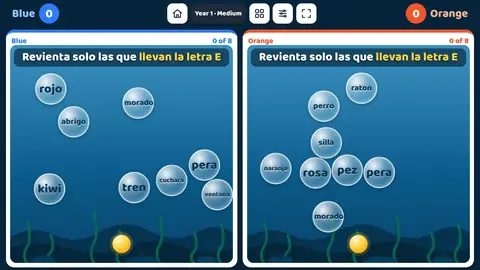
Pop the bubbles
A rule appears at the top — “only even numbers”, “only multiples of 3”, “only animals” — and bubbles float up carrying a number or a word. Pop ONLY the ones that match, by throwing the ball: drag from it, or tap the bubble itself. A hit scores; popping a wrong one costs a point. The rule changes every four hits.
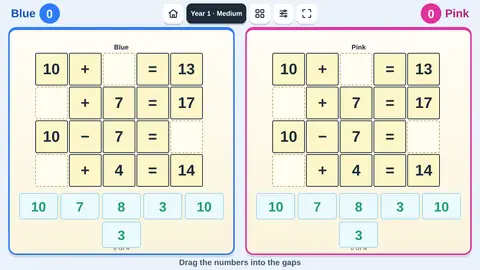
Maths crossword
A grid of crossed sums with gaps: drag the numbers from the bank until every calculation works out.
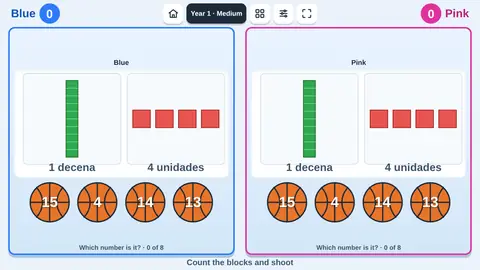
Hundreds, tens and ones
Hundred flats, ten rods and unit cubes appear: count them and shoot the ball with the right number.
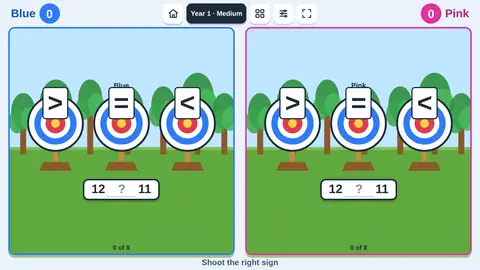
Greater, less or equal
Two numbers appear and you shoot the target with the right sign. Also with sums and subtractions on both sides.
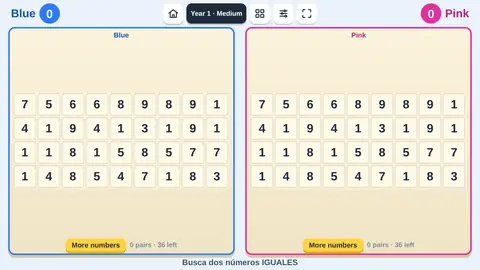
Make ten
Tap two numbers that are the same or add up to 10 and they explode. Clear the board before the other team.
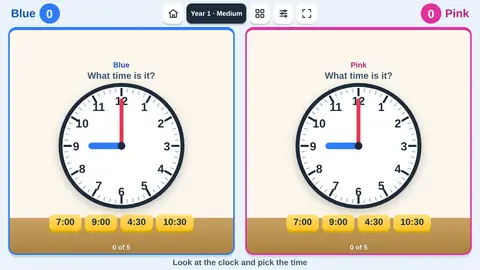
The clock
Two challenges: read the clock and pick the right time, or drag the hands to set the time you are asked for.
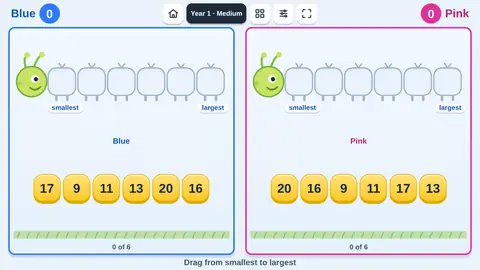
The number caterpillar
The numbers are the segments of a caterpillar: drag them into place, smallest to largest (or the other way round). From 3 to 10 segments, up to 10000.
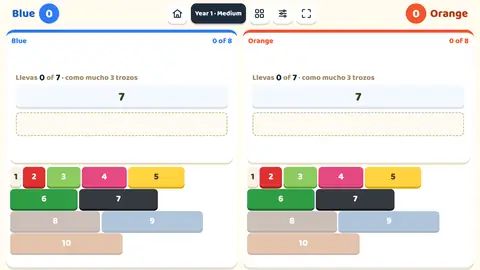
Make the number
A number appears and you fill its bar exactly with coloured rods: 9 can be 6 and 3, or 5 and 4, or 4 and 4 and 1. Tap a rod you have placed to take it back.
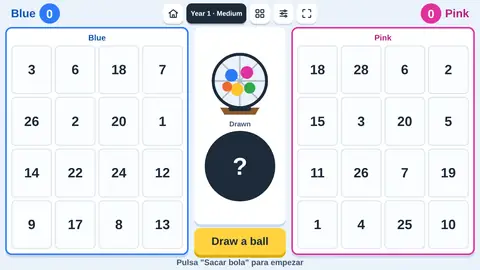
Bingo
A ball comes out and each team looks at their card. With numbers, coloured shapes, animals or sums: 7 + 2 comes out and you mark the 9.
Language and literacy
10 games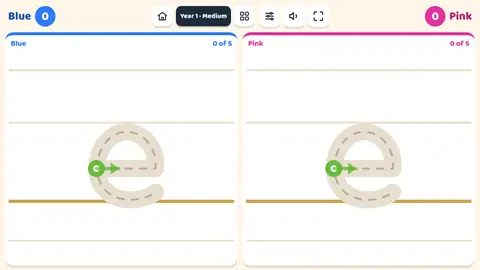
Trazos de letras y números
Sigue el punto verde y la flecha para escribir cada letra en su pauta, trazo a trazo y en el orden correcto. Por equipos, cada uno traza la misma letra en su mitad; o solo, para practicar.
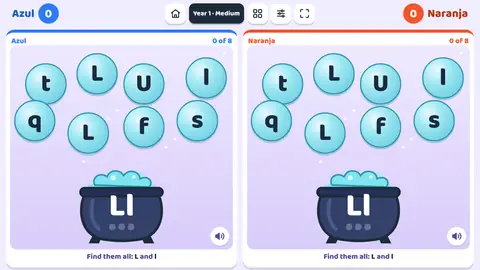
The letter cauldron
A letter appears on the cauldron and you put in every bubble with that letter, capital and lowercase. Tap them or drag them with your finger. Vowels, first letters or the whole alphabet, in print or joined-up letters.
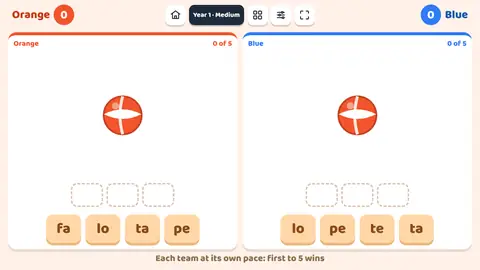
Sílabas saltarinas
Sale un dibujo y las sílabas desordenadas. Cada equipo las toca en su mitad hasta formar la palabra.
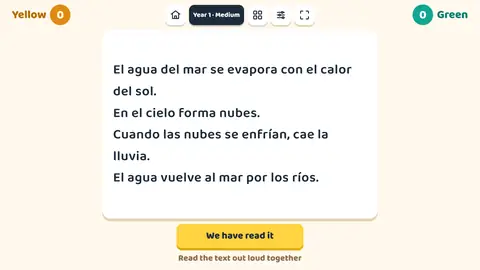
Leer y entender
Un texto corto y preguntas para los dos equipos a la vez. Se responde tocando el dibujo o la palabra correcta.
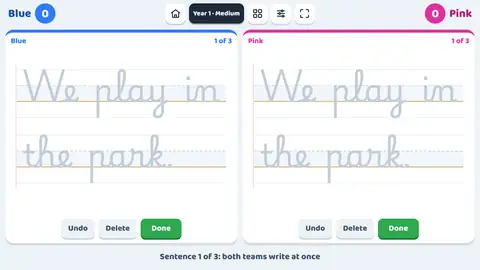
Handwriting
A sentence appears in joined-up handwriting and you write it on notebook lines with your finger or the board pen. The game scores the handwriting: following the model, sitting on the line, the right size and spaces between words. In teams, the neatest writing wins.
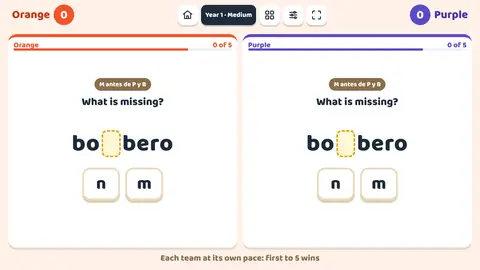
Duelo de ortografía
Cada ronda cambia: elegir la palabra bien escrita, completar la letra que falta o cazar el error de una frase. Más de 200 palabras, con la regla de cada curso.
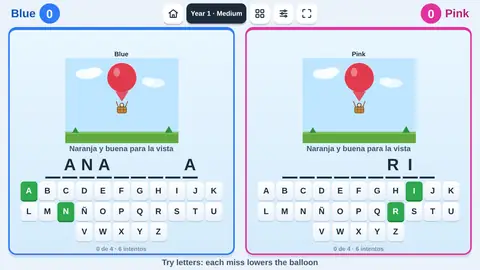
Balloon hangman
A hidden word with a clue. Every wrong letter brings the balloon down; if it lands, that word is over.
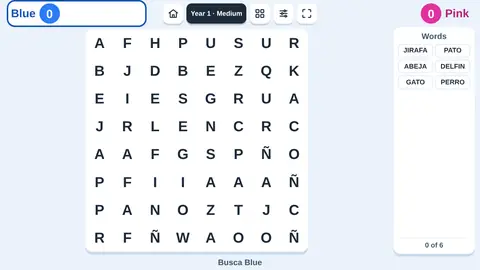
Word search
Drag across the letters to find the words on the list. By topic: animals, food, school, the body or English.
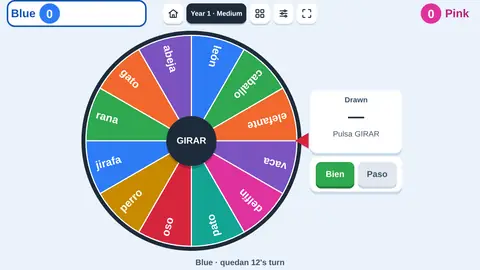
The word wheel
The wheel spins and lands on a word: say it in English, use it in a sentence, count its syllables or find a rhyme.
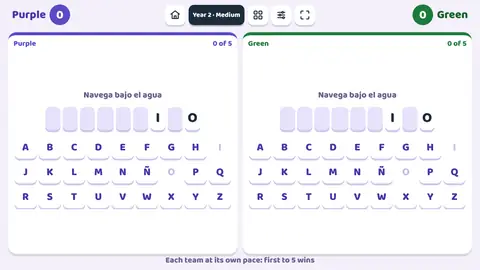
Ruleta de palabras
Palabra escondida con pista. Los dos equipos a la vez, cada uno con su teclado y a su ritmo: gana quien descubre antes cinco.
English
16 games
Sentence Builder
To start with no English: hear a word or a sentence and tap the picture. Then each team builds the sentence with coloured cards: who, what doing, what and where.
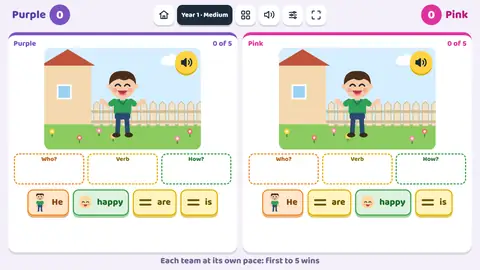
I am, you are
Pronouns and the verb to be through play: hear She is happy and tap the picture. Then each team builds sentences like I am happy, they can swim or he likes apples.
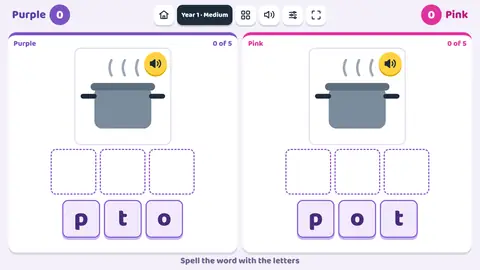
Phonics
Reading English by sounds, the way English schools teach it: the first sound of each word, reading words like c-a-t by blending their sounds, and spelling them with letters.
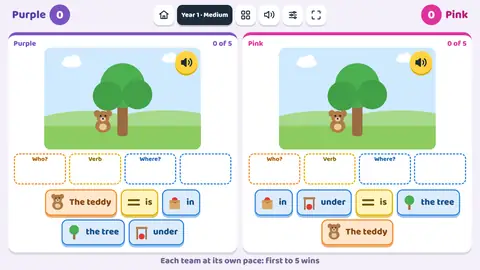
In, on, under
Where things are: hear The cat is under the table and tap the picture. Then build the sentence with coloured cards. In, on, under, next to, behind and in front of.
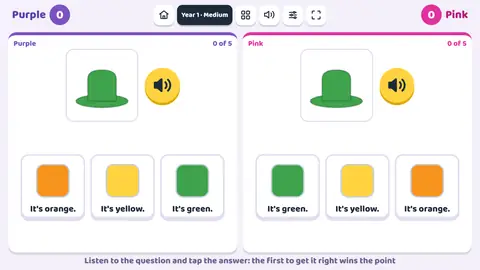
Ask and answer
The voice asks about a picture and each team taps the right answer: Is it a dog? Yes, it is. What colour is it? It's red. How many ducks? Three.
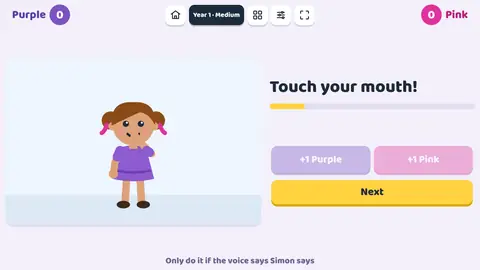
Simon says
To get the class moving: the voice gives an order in English and everyone does it. If it does not start with Simon says, whoever moves is out. The teacher gives the points.
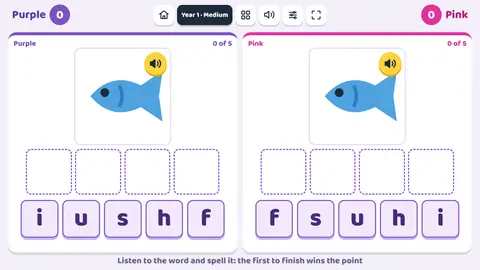
Spelling bee
The spelling contest from English schools: the voice says the word and a sentence, and both teams spell it at the same time with letters. From cat to because.
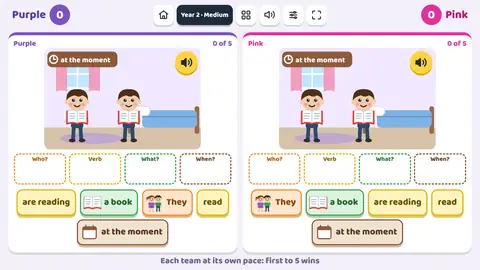
Past, present, future
English tenses with coloured cards: the sign on the picture says when it happens and you choose plays, played, is playing or is going to play.
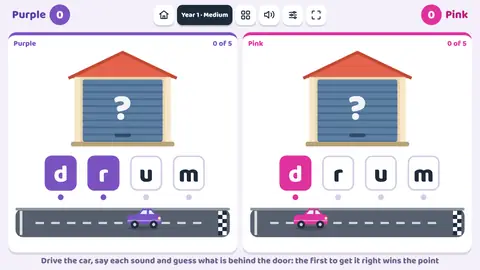
Blending road
Reading sound by sound: drive the car along the road, each letter lights up as you pass and at the end the garage opens to show the picture.
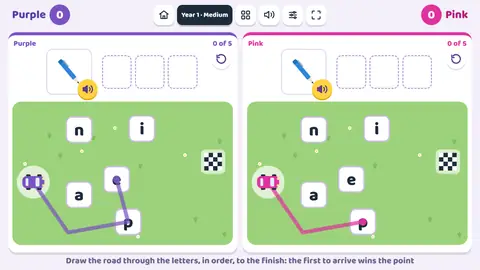
Spelling road
Spelling sound by sound: draw the car’s road with your finger through the letters, in order, to the finish. Run over a wrong one and start again.
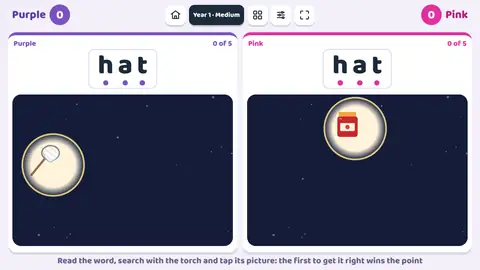
Torch hunt
Everything is dark: move the torch with your finger and the pictures appear. Find the one that matches the word you read or hear.
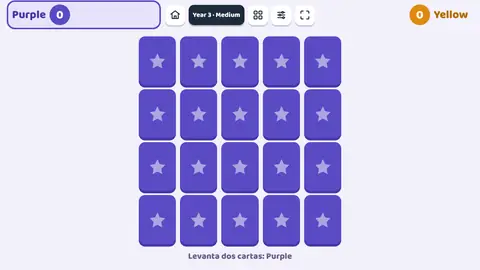
Pairs in English
Memory in English: each pair matches a Spanish word with the same word in English, like gato and cat or sol and sun.
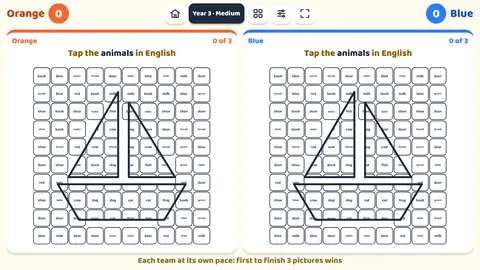
Colour by code in English
Colour by code with English words: tap the squares with the colours, animals or numbers the instruction asks for and the hidden picture appears.
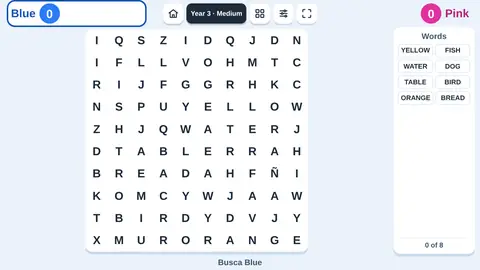
Word search in English
The word search with English words to find in the grid: cat, dog, house, school, friend...
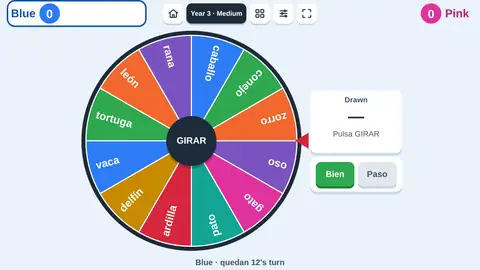
Word wheel in English
Spin the wheel and a Spanish word comes up: the team has to say it in English.
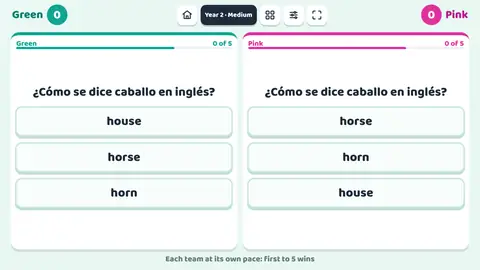
Question duel in English
English questions for both teams at once, against the clock: animals, colours and numbers, the classroom, the house, the body, days and weather.
Logic and memory
24 games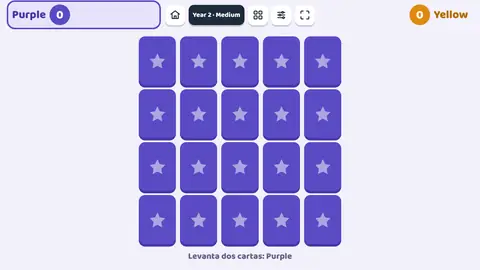
Memory pairs
Turn two cards over and find the pairs. Pictures, words or numbers.
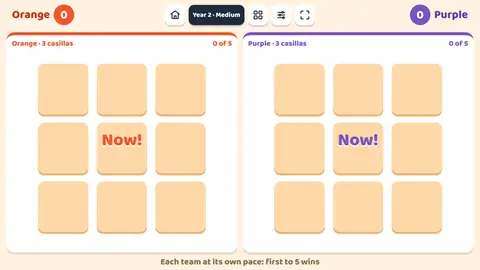
Team memory
Squares light up in order and both teams repeat the sequence at the same time, each on their own grid.
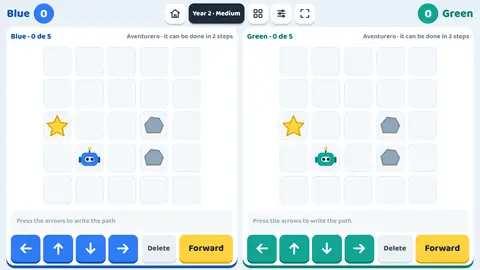
The lost robot
Six challenges on one grid: reach the star, dodge rocks, use repeats, collect nuts, do it in the exact number of steps and fix a buggy program.
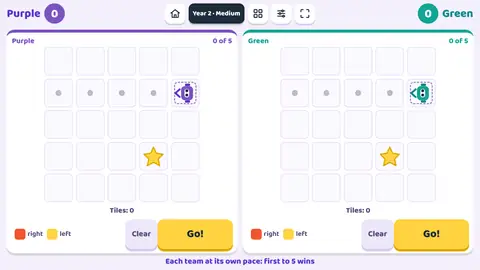
The colour robot
It only understands colours: red turns right, yellow turns left. Place tiles so it reaches the star. No reading at all.
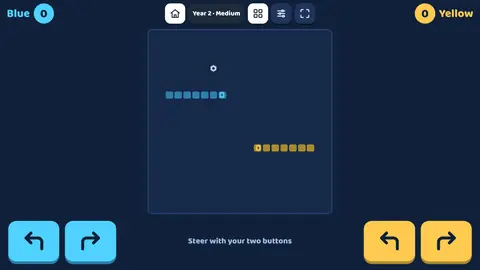
Robot snake
Both robots drive on their own leaving a trail and each team steers with two buttons. Crash and you lose the round.
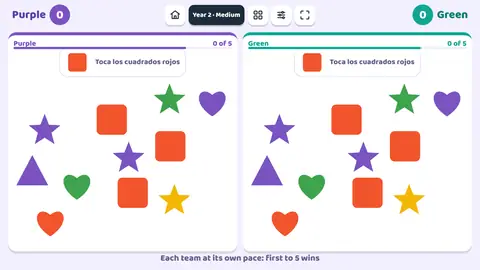
Shape and colour hunt
Find every shape that matches the model. Both teams at once, each on their own field.
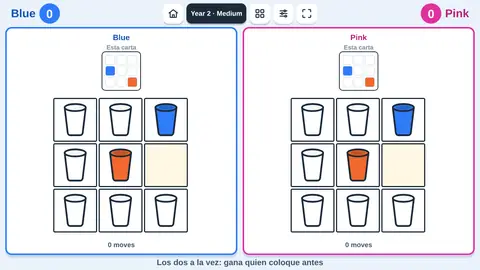
The cups
A card shows where the coloured cup goes. Tap a cup and a square and they swap. First to place it wins the point.
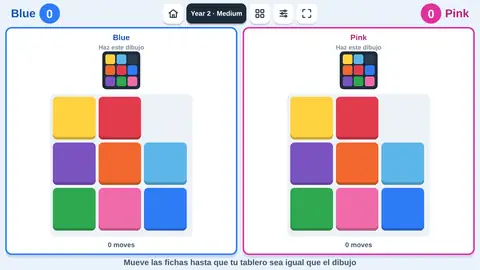
The colour cube
A colour pattern appears at the top and you copy it by sliding the tiles through the empty space, like the puzzle toy.
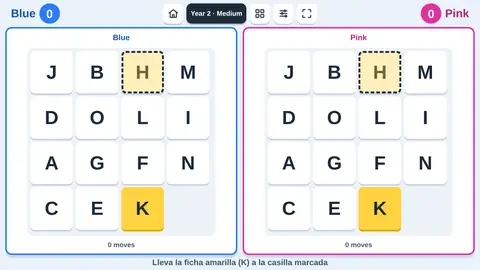
Sliding puzzle
Tiles and one empty space: tap a tile next to it and it slides. Get the yellow tile to its square, or put them all in order.
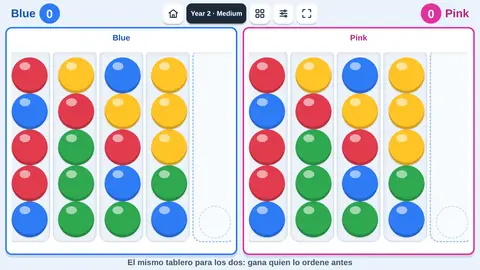
Colour towers
Leave each column in a single colour by moving the top piece. Both teams start from the same board: first to sort it wins.
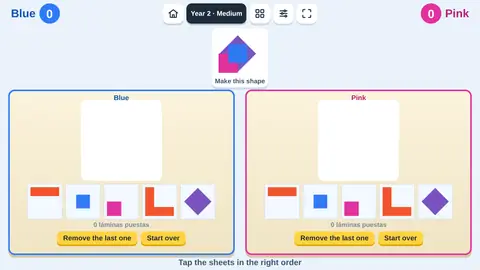
Colour layers
A coloured shape appears. Tap the transparent sheets to stack them: each one covers the ones below, so you need the right sheets in the right order.
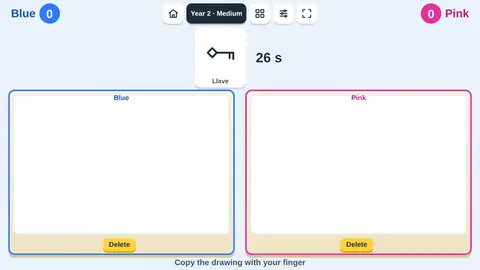
Copy the drawing
A drawing appears and each team copies it with their finger. At the end both drawings stay on screen and the class decides who did it best.
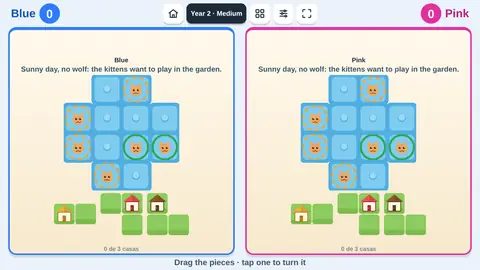
Here comes the wolf
When the wolf comes, every kitten needs a house and the wolf must stay out. On sunny days it is the other way round. Garden pieces with one house each, in different shapes.
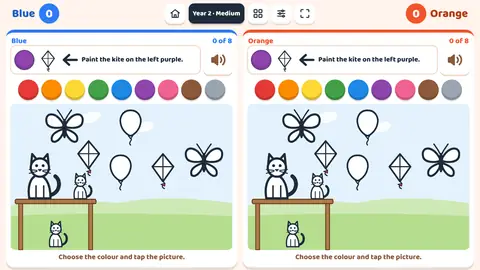
Paint what I say
An instruction is spoken and shown with pictures, such as "paint the big balloon red", and you paint the picture by choosing the colour and tapping the drawing. It starts with colour and object and moves on to sizes, amounts, where things are, left and right, all but one and first, second, third.
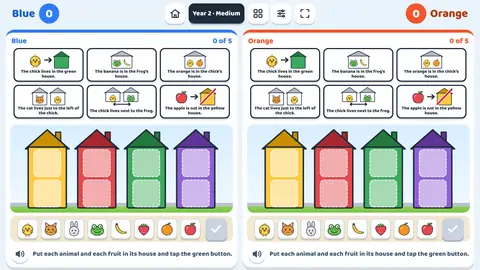
Who lives in which house?
Picture logic puzzles: a street of coloured houses and clues such as “the cat lives in the red house” or “the frog lives just to the left of the chick”. Put each animal in its house and check. At the higher levels each house also has a fruit or a toy.
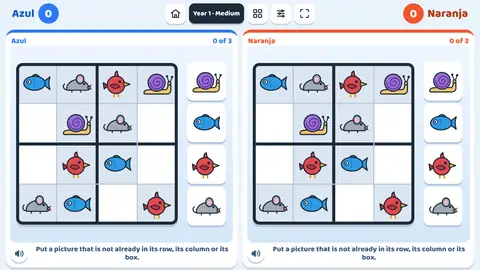
Picture sudoku
A grid of pictures where none repeats in its row or column. Tap the square and the picture, or drag it. From a 3 × 3 with one gap to a 6 × 6 with boxes, with animals, fruit, colours or numbers.
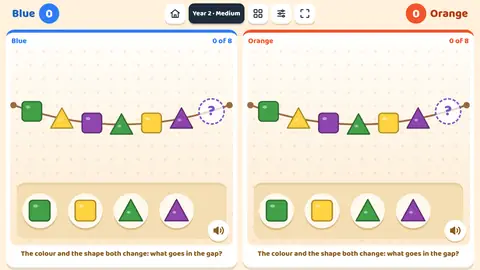
What comes next?
A necklace shows a pattern with a gap: see how it repeats and add the missing bead by tapping or dragging it. It starts with AB and goes up to growing patterns, turning arrows, two gaps or finding the bead that is wrong.
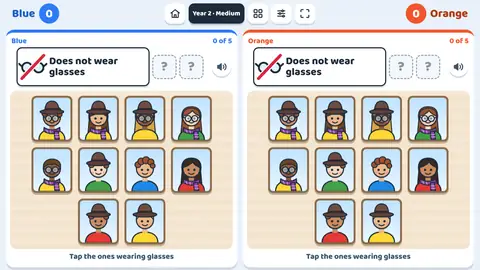
The detective
Find one character by following clues: wears a hat, no glasses, dressed in blue. Tap the ones that do not match and their window closes until only one is left. At the top level all the clues come at once.
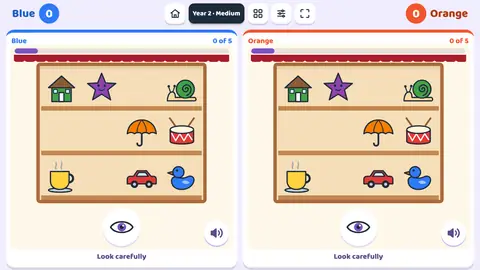
What has changed?
Look at the shelf for a few seconds, the curtain closes and something changes: find what is missing, what is new, what changes colour or what swaps places. After a mistake, the before and after are shown with the change marked.
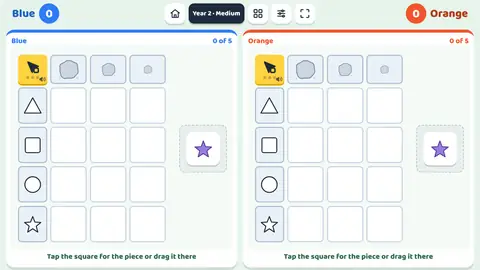
The double-entry table
Every piece goes where its row and its column meet: colour and shape, animal, amount or size. Place pieces, choose the one for a square, fill in the whole table or find the pieces in the wrong place.
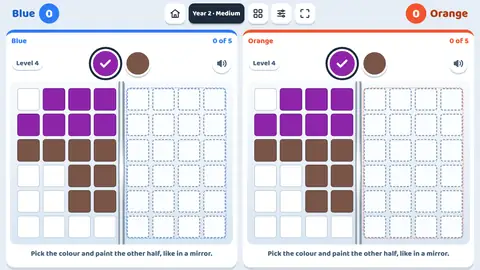
The mirror
There is a picture on one side of the mirror and you paint the other half, reflected. Tap each square or drag your finger. One to three colours, with the mirror standing, lying down or two mirrors at once.
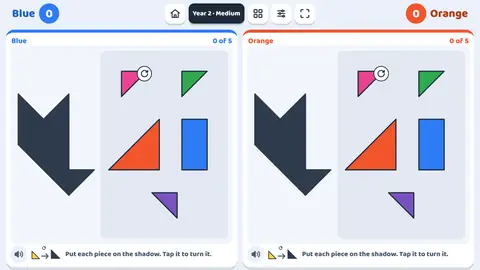
Silhouettes
The shadow of a picture appears with coloured pieces below. Drag each piece to its place and tap it to turn it until it fits. From level 1, with two pieces and the lines marked, to level 5, with seven pieces and only the outline.
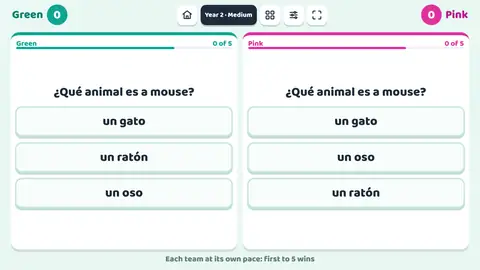
Duelo de preguntas
Pregunta y tres respuestas, los dos equipos a la vez y a contrarreloj. Bancos de entorno, mates e inglés, y editor para meter las tuyas.
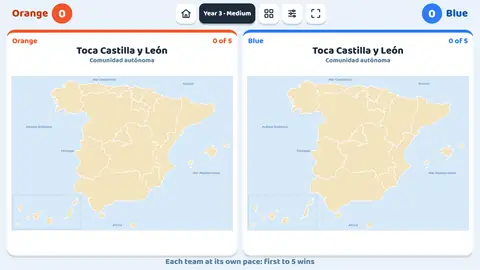
Mapa de España
Mapa real y táctil de España: comunidades autónomas, provincias y sus capitales. Canarias en recuadro.
Music
2 games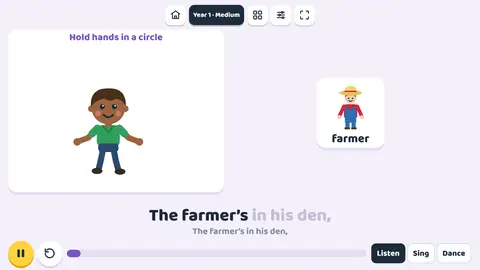
Sing and dance
45 songs in English, sung in a British voice or traditional as karaoke: listen with the words and pictures, sing along, dance the moves or play in teams to find the missing word.
Piano
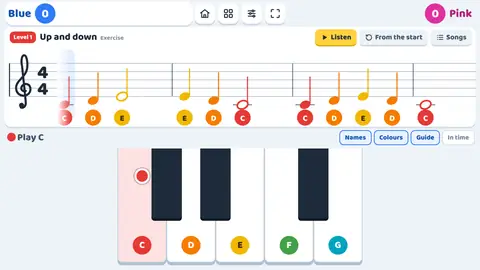
A big piano with simple sheet music, level by level: listen to the song and play it note by note, with each note named and coloured. From C-D-E to Für Elise.
Classic games
8 games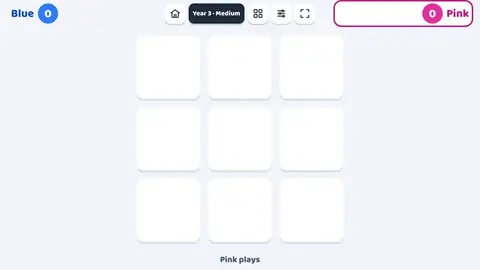
Tic-tac-toe
The classic, big and by turns: three in a row wins. In solo mode you get puzzles: find the winning square.
Connect 4
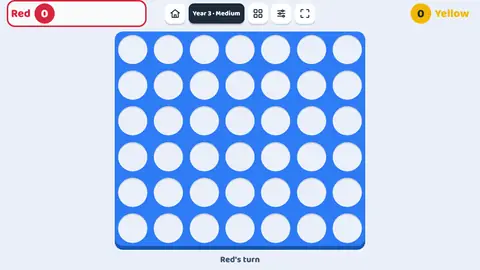
Tap a column and the disc drops. Four in a row wins. Solo mode gives puzzles: find the winning column.
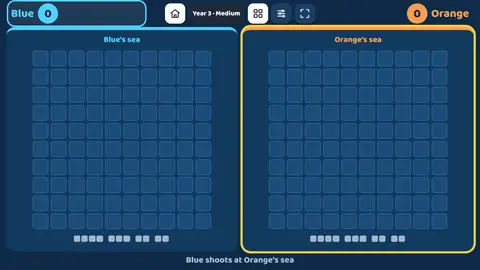
Battleships
Each team has its own sea with the ships placed at random. Hit and shoot again, miss and the turn passes.
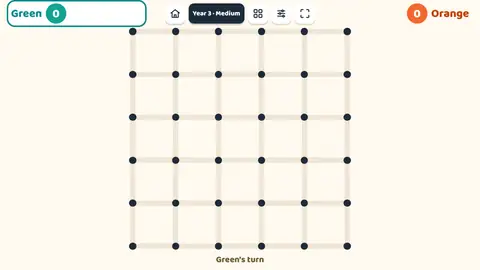
Dots and boxes
Tap a line between two dots. Close the fourth side and the box is yours, plus another go.
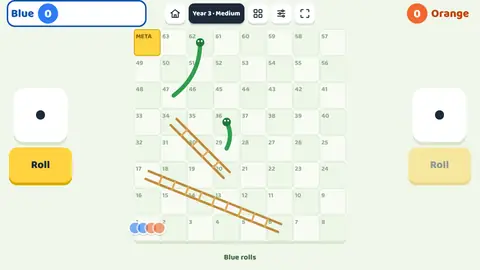
Snakes and ladders
Two counters per team and you choose which one to move. Land on a rival and send it back to the start.
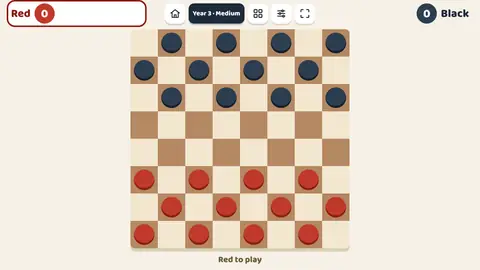
Draughts
Tap the piece and the green square it moves to; red squares are captures. Reach the far row and it is crowned.
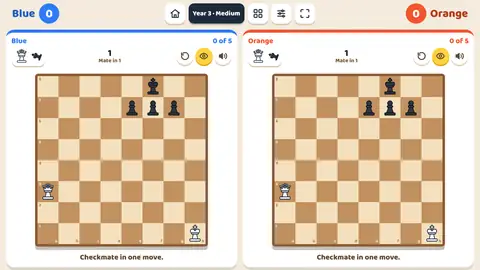
First steps in chess
An introduction to chess with short challenges: each piece is introduced on its own and you learn how it moves by reaching the star and collecting stars in as few moves as possible. Then capture without being captured, promote the pawn and checkmate in one move.
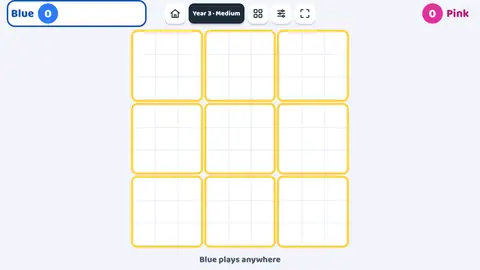
Ultimate tic-tac-toe
Nine boards in one: the square you tap decides where your rival must play. Three boards in a row wins.
How it works
Pick a game
By year group, subject or format. Nothing to install: it opens in the browser of the board, the tablet or the iPad.
Set the level
Year and difficulty, two teams or one child alone, and how many pupils each team has so they take turns.
Play
One team on each side of the screen, playing with a finger. You can also play on two screens: one creates a room and reads out a four-letter code.
What you get
- 78 games from Early years to Year 6: maths, language, logic and the classics.
- Levels inside each game, so one game covers the whole class and works for extra support too.
- Spanish, Catalan, English, French and German, switched with one tap.
- Works offline once loaded, and installs as an app on the board or the tablet.
- No accounts for pupils and no adverts. We ask for no data about the children.
- 5 free games with no sign-up. After that, one single payment unlocks everything for ever.
- One licence covers both screens. Whoever creates the room provides the account; the other joins with the code, with no payment and no sign-up.
Every game, one by one
What each game teaches, its levels and how to use it in class.
Maths
- Tug of war
- Camel race
- Balloon race
- Block tower
- Colour by code
- Penalty shootout
- Maths tic-tac-toe
- Square conquest
- How many are there?
- The two parts
- Join the dots
- The scales
- Catch the ghost
- The hundred square
- Pop the bubbles
- Maths crossword
- Hundreds, tens and ones
- Greater, less or equal
- Make ten
- The clock
- The number caterpillar
- Make the number
- Bingo
Language and literacy
Logic and memory
- Memory pairs
- Team memory
- The lost robot
- The colour robot
- Robot snake
- Shape and colour hunt
- The cups
- The colour cube
- Sliding puzzle
- Colour towers
- Colour layers
- Copy the drawing
- Here comes the wolf
- Paint what I say
- Who lives in which house?
- Picture sudoku
- What comes next?
- The detective
- What has changed?
- The double-entry table
- The mirror
- Silhouettes
- Duelo de preguntas
- Mapa de España