Sentence Builder
It starts from zero: the voice says a word or a sentence in English and children tap the matching picture, with no reading needed. Then they move on to building the sentence with coloured cards: each team taps the parts in order in its half of the board until it has, for example, The girl is eating an apple, and the voice reads it in British English. The sentences and the voice are always in English.

What children practise
- Put an English sentence in order: who, what doing, what and where
- Use the present continuous (is eating, is running) to say what is happening in a picture
- Vocabulary for animals (farm animals too), food, things at home and at school, and places
- Comprehension: pick the card that really matches the picture and leave out the one that does not
- Hear the pronunciation of each part and of the whole sentence
Levels and settings
Early years
Listen and tap: the voice says Find the cat! and children tap its picture out of two or three. On the hardest setting they hear a sentence, such as The dog is sleeping., and tap the scene. No reading needed.
Y1
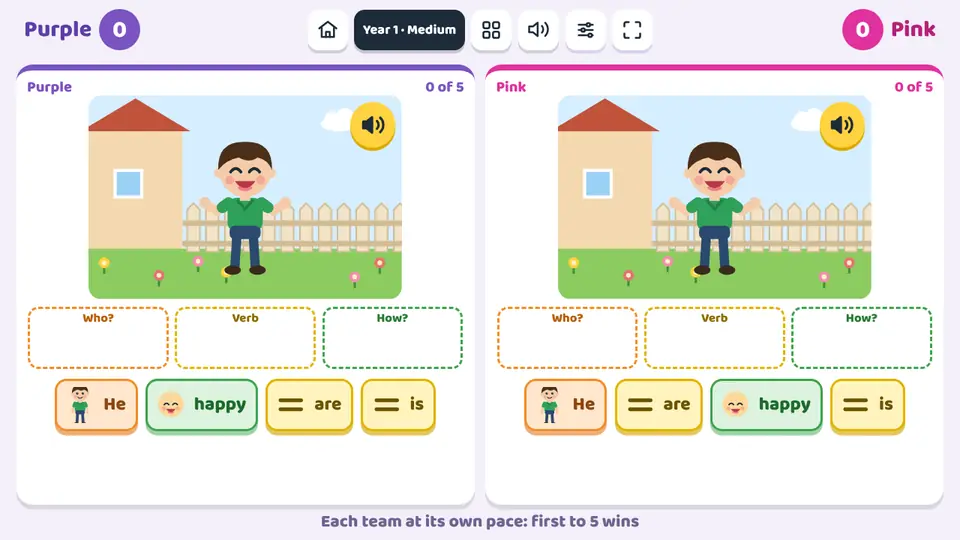
First they listen to the sentence and choose between three scenes; then they build two- and three-part sentences with coloured picture cards, with a speaker button to hear the sentence.
Y2
Three or four parts, with where: The boy is reading a book in the park. On the hardest setting the cards have no colours or pictures.
Extra cards
None, one or two cards that do not belong, so children have to look carefully at the picture before tapping.
How to play it in class
- Choose the year group and difficulty or, under More options, the sentences, extra cards, hints, voice and points to win.
- Press Start: each team sees the same picture in its half of the board.
- In the listening levels the voice says the word or sentence (the speaker repeats it) and the first team to tap the right picture wins the point. In the building levels, tap the cards in order: orange for who, yellow for what doing, green for what and blue for where.
- If a card does not fit, it shakes and that half pauses for a moment; after three mistakes the sentence is shown. The first team to reach the target wins.
Ways to play
In teams, at the same time
The screen splits in two and each team plays on its own half at the same time.
For one player
One child plays on the whole screen at their own pace: on the whiteboard, a computer or a tablet.
Frequently asked questions
Does it work for children who know no English and cannot read yet?
Yes. The early years levels are only listening and tapping the picture, with no reading, and if they tap the wrong one the voice says what it is.
Why does each part of the sentence have a colour?
It is how many British schools teach sentence building: who in orange, what doing in yellow, what in green and where in blue. The colours make the word order visible.
Can the voice be turned off?
Yes. In the settings you choose whether it reads each card and the sentence, only the sentence or nothing, and the speaker button mutes it at any time.
Is it free?
You can play 5 free games without signing up. After that, a one-off payment of €9.99 unlocks all 78 games for ever, on all your devices. There is no subscription.
Do I need to install anything?
No. It opens in the browser of the interactive whiteboard, panel, computer, tablet or iPad. Once loaded, it also works offline.
More English games
 I am, you arePronouns and the verb to be, learnt the way English schools teach them: with pictures and whole sentences, not conjugation tables.
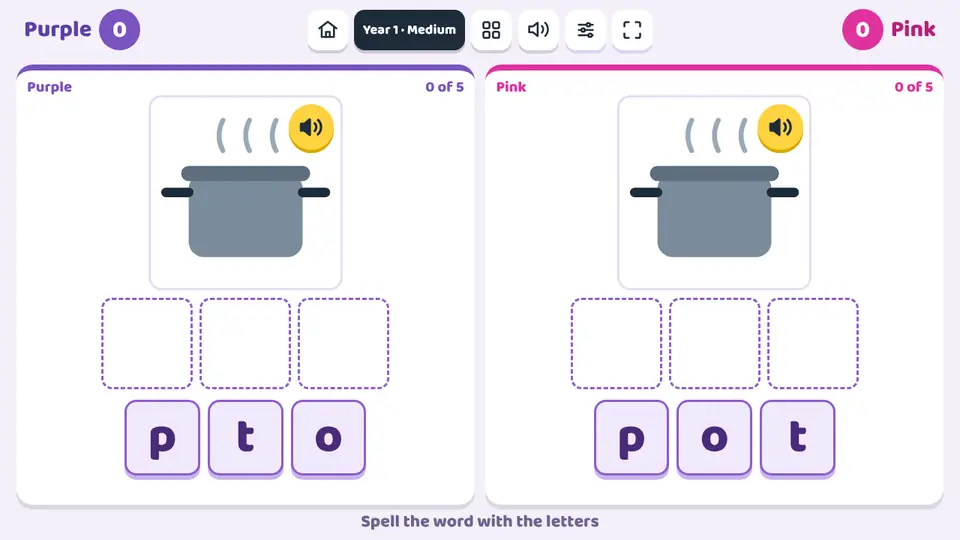 PhonicsEnglish schools teach reading through sounds, not letter names.
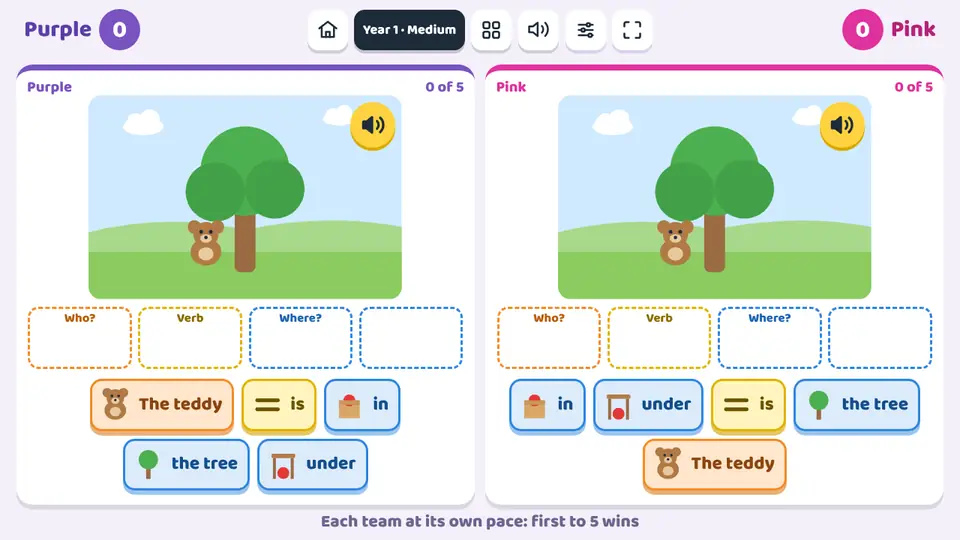 In, on, underPrepositions make sense when you can see them: a cat on the table, a ball in the box.
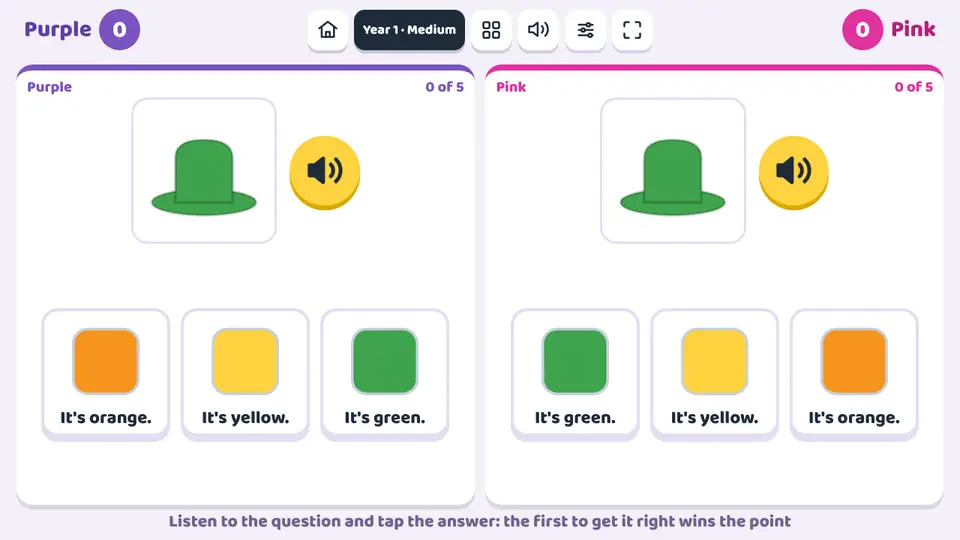 Ask and answerShort answers come early in English: Yes, it is; No, it can’t; It’s red.
Sentence Builder
Play now