I am, you are
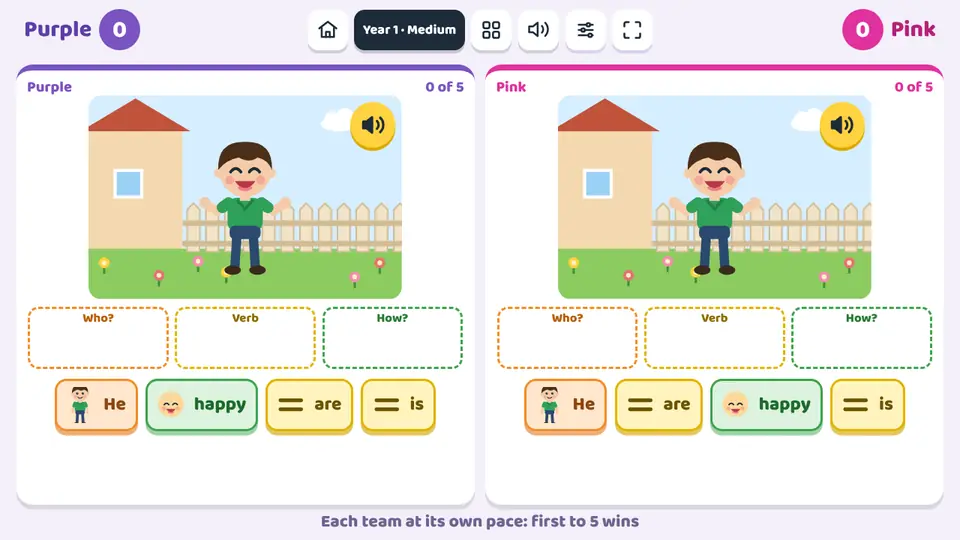
Pronouns and the verb to be, learnt the way English schools teach them: with pictures and whole sentences, not conjugation tables. The voice says She is happy and you tap the scene; then each team builds the sentence with coloured cards and has to choose am, is or are. There are also sentences with can (they can swim) and like (he likes apples).
What children practise
- Personal pronouns: I, you, he, she, it, we and they
- The verb to be in the present: I am happy, she is in the kitchen, they are running
- Saying what you can do with can: I can swim, it can fly
- What you like, have and do: I like cake, he has a dog, we eat pizza
- The -s after he, she and it: likes, has, eats, plays
- Feelings, places, actions, food, toys and animals (farm animals too)
Levels and settings
Early years
Listen and tap: the voice says He, She, It or They and you tap the picture out of two or three. On hard, whole sentences like She is happy. No reading needed.
Year 1
First you hear the sentence and pick the scene out of three; then you build it with three cards (who, verb and how) choosing between am, is and are.
Year 2
All the pronouns, including I, you and we, and every kind of sentence: am, is and are, can, like and likes, have and has, eat and eats. On hard, the cards have no colours or pictures.
The pictures
Whoever is speaking has a speech bubble (I, we) and whoever is spoken to has a hand pointing at them (you); he, she, it and they have nothing.
How to play it in class
- Choose the year and the difficulty or, in More options, the level, the sentences (to be, can, like or mixed), the pronouns, the extra cards, the hints, the voice and the points.
- Press Start: each team sees the same thing in its half of the board.
- In the listening levels, the first team to tap the right picture wins the point. In the building levels, you tap the cards in order: orange who, yellow the verb and green how they are, what they can do or what they like.
- If a card does not fit, it shakes and that half pauses for a moment; after the third mistake the sentence is shown. The first team to reach the goal wins.
Ways to play
In teams, at the same time
The screen splits in two and each team plays on its own half at the same time.
For one player
One child plays on the whole screen at their own pace: on the whiteboard, a computer or a tablet.
Frequently asked questions
Does it work for children who know no English at all?
Yes. The early years levels are just listening and tapping the picture, with no reading, and if they tap the wrong one the voice repeats what they are looking for.
Why not conjugate the verb to be in a table?
Because English schools teach it by using it: whole sentences about what you can see. The extra cards make children choose between am, is and are or like and likes, which fixes the right form.
How do you tell I, you or he apart in the picture?
Whoever is speaking has a speech bubble (I, or we if there are two), whoever is spoken to has a hand pointing at them (you), and he, she, it and they have nothing.
Is it free?
You can play 5 free games without signing up. After that, a one-off payment of €9.99 unlocks all 78 games for ever, on all your devices. There is no subscription.
Do I need to install anything?
No. It opens in the browser of the interactive whiteboard, panel, computer, tablet or iPad. Once loaded, it also works offline.
More English games
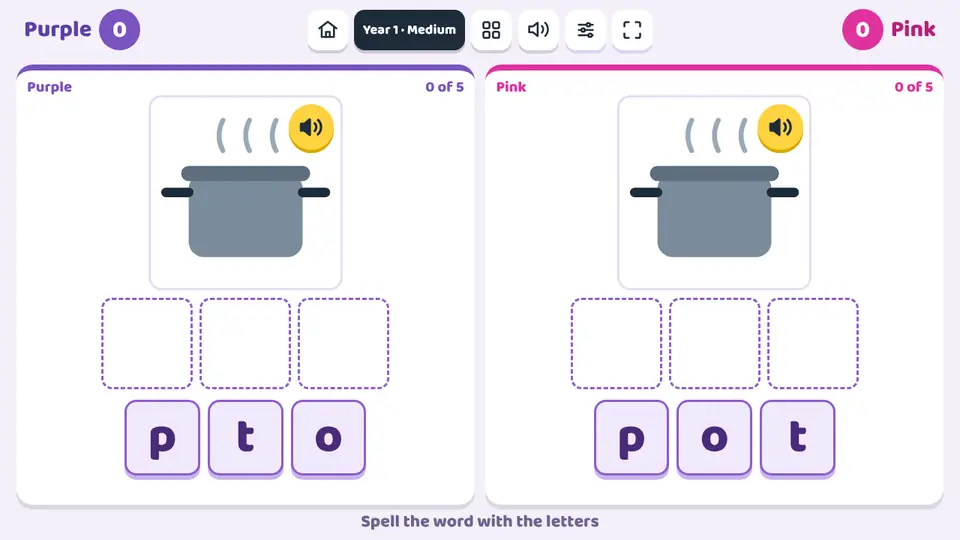 PhonicsEnglish schools teach reading through sounds, not letter names.
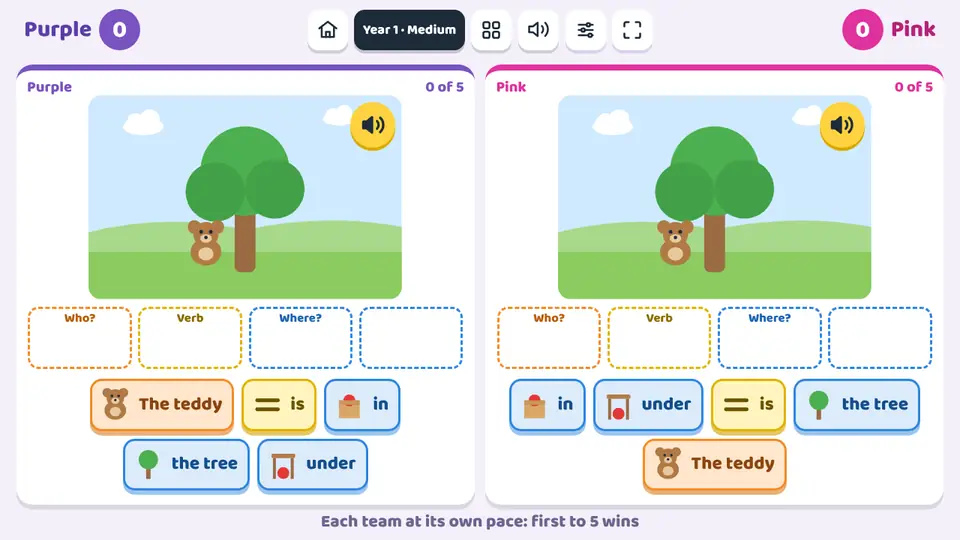 In, on, underPrepositions make sense when you can see them: a cat on the table, a ball in the box.
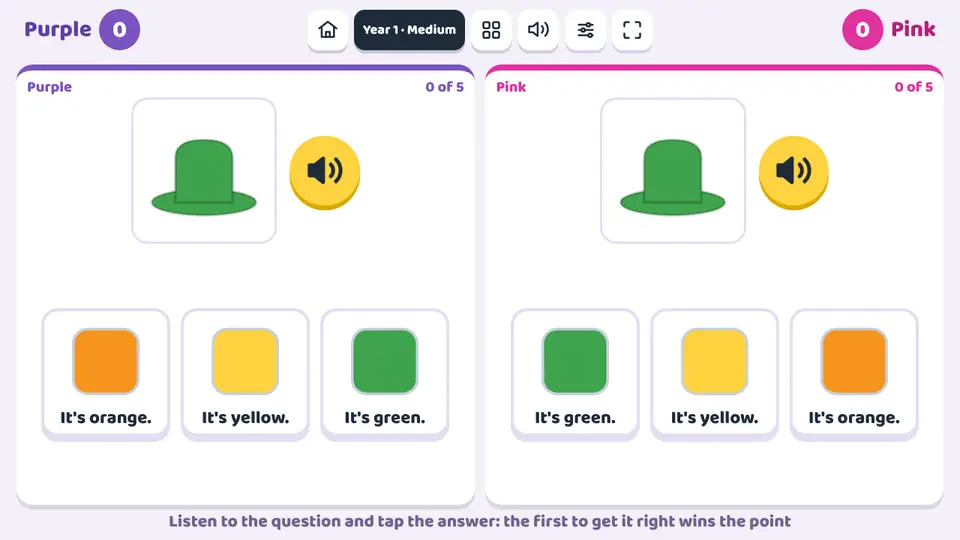 Ask and answerShort answers come early in English: Yes, it is; No, it can’t; It’s red.
 Simon saysIt is the classic game of English schools and a way to learn English by moving.
I am, you are
Play now